Case study
AceTheRound: from AI coaching idea to MVP with Argonous
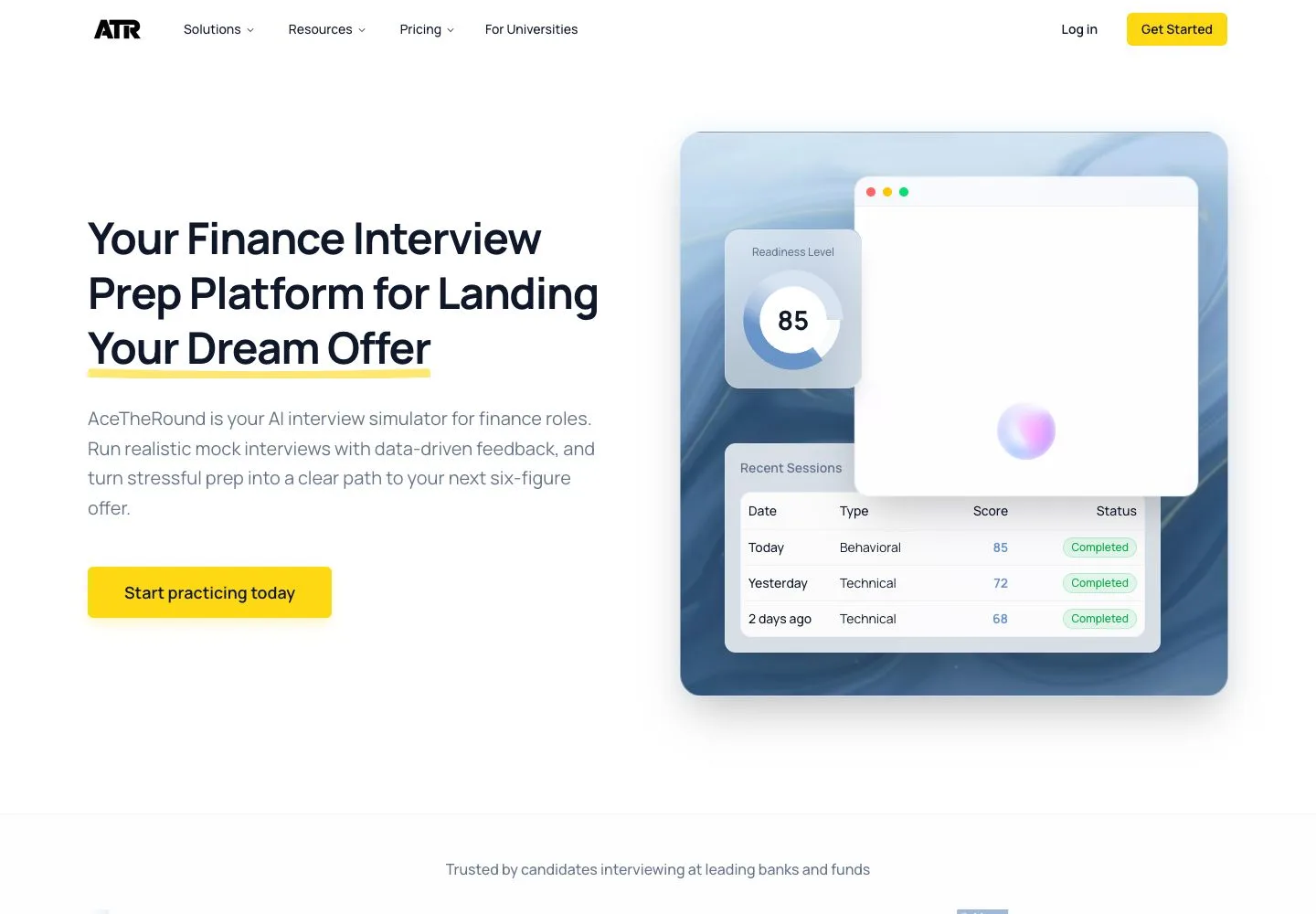
Argonous took AceTheRound from an AI interview-coaching idea to an MVP, connecting interview practice, feedback, CV processing, accounts and billing.
By Argonous · Published · Updated
What we delivered
Interview practice and feedback
Voice interviews connected to analysis and a results screen.
CV and account workflows
Profiles and CV processing connected to interview preparation.
Credit-based access
Purchases and interview usage connected to account balances.
Project at a glance
- Product
- AceTheRound — AI interview coaching
- Argonous role
- CTO services, technical leadership and end-to-end MVP development
- Scope
- Web application, AI voice and analysis, CV processing, accounts, billing and infrastructure
The challenge
AceTheRound's founder wanted to help people practise interviews and receive feedback they could use to prepare. Turning that idea into a product required a complete experience: users needed to create an account, prepare for an interview, speak with an AI interviewer and review the results afterwards.
Argonous provided the technical leadership and development to take the product from idea to MVP. Working with the non-technical founder's direction, we translated the concept into application flows, integrated the AI services and built the backend systems that connected the experience.
Our responsibility extended across the product. We owned the connections between the interface, voice conversations, analysis, document processing and payments, keeping the interview journey at the centre of the build.
What we built
We developed a web application covering profile creation, CV uploads, technical and behavioral interviews, voice conversations, feedback, interview history and dashboard views. We also implemented credit-based billing and free-trial access to support how users entered and used the product.
We integrated specialist services for voice, identity, storage, payments and email, then connected them to AceTheRound's workflows. The application uses SvelteKit and a Python backend, with integrations including Retell, Supabase and Stripe.
A core part of our work was turning a completed conversation into useful feedback. We connected interview completion to background analysis and a results screen, with processing states that let the application show progress while the analysis ran.
Making AI feedback fit the experience
Interview types needed different analysis → defined response formats and an explicit selection flow → feedback could match the chosen interview.
Technical and behavioral interviews require different analysis. We implemented defined response formats for each interview type so the application could work with consistent fields for scores, feedback and recommendations.
As we evolved the analysis layer, we built an adapter to translate new model responses into the format existing application components expected. This let us update the AI integration incrementally while maintaining compatibility with the surrounding product.
We also addressed a failure in how the application carried interview selections through to analysis. An early default could start technical analysis before a behavioral interview's selection was available. We changed the affected flow to wait for the explicit interview type and aligned the feedback screen with the backend response.
The product requirement was clear: the feedback needed to match the interview the person had chosen. We addressed that requirement across the interface, request handling and analysis service together.
Keeping the journey moving while analysis runs
Analysis could outlast the initial request → queues and workers tracked processing → the application could show pending, completed or failed states.
Long-running analysis introduced a different challenge. Basic service checks could succeed while the requests needed to produce feedback failed. We worked across request routing, waiting times and background processing to separate the analysis workload from the immediate user request.
We implemented queues and dedicated workers so the application could track a job while processing continued. Separate queues handled interview analysis and CV processing, with job status and expiry supporting the processing lifecycle.
We also added error handling that distinguishes a missing voice-call record from other provider failures. That distinction gives the application a clearer basis for handling problems than a generic error.
For the user, this work supports the transition from finishing an interview to receiving feedback. We built the processing states and service connections needed to represent that transition, including when work is pending or has failed.
Connecting payments to product access
Purchases and usage needed to update balances → coordinated credit updates and checks for repeated events → access was connected to the account.
We implemented credit-based access to connect purchases and interview usage to account balances. That required handling the events after checkout as well as the checkout itself.
We added database functions for coordinated credit updates and persistent checks for previously processed payment events. These safeguards address conflicting balance changes and repeated payment notifications, both of which can arise when separate services update the same account.
By including billing behavior in the application build, we connected the payment integration to the access users receive inside the product.
Turning CV uploads into interview context
Uploaded CVs needed processing before use → a pipeline extracted and checked structured information → interview preparation could use professional context.
We built a document-processing pipeline to convert uploaded CVs into structured information for interview preparation. The pipeline handles document conversion, language information, personal-information detection and sanitization, content extraction and quality checks.
We added progress updates for the processing stages so the application could distinguish an uploaded document from one still being processed or ready to use. Privacy safeguards formed part of the pipeline design, alongside the handling of processing errors and incomplete results.
This brought document ingestion into the same product workflow as profiles and interview preparation, giving AceTheRound a foundation for working with a user's professional context.
The result
Argonous took AceTheRound from a founder's idea to an MVP connecting AI interviews, analysis, CV processing, account management and billing. We delivered the application and the supporting services, with technical ownership spanning the user experience and the infrastructure behind it.
The engagement demonstrates how our CTO and MVP development services work together: translate a founder's direction into a defined product, build the complete journey and resolve the integration problems between its parts. AceTheRound gained a concrete product foundation to review, refine and develop further.