Case study
HumSpark: building a shared knowledge vault with Argonous
HumSpark needed a shared home for the knowledge and working documents behind its agency work. Argonous built a version-controlled knowledge vault that brings company context, delivery guidance, project records and reusable documents into one navigable structure. Designed for both people and AI collaborators, the vault combines ordinary Markdown files with defined metadata, links, generated views and local validation. The result is a foundation for finding information, understanding its status and keeping new work connected to its sources.
By Argonous · Published · Updated
What we built
Connected knowledge
A navigable repository linking company context, projects and sources.
Clear status and ownership
Defined metadata and working rules distinguish information from human approval.
Reusable working tools
Templates, generated views and local checks support consistent records.
Project at a glance
- Client
- HumSpark
- Argonous role
- Knowledge-vault design and build
- Scope
- Repository structure, navigation, templates, record-creation tools and local validation
The challenge
Agency work produces more than finished websites. It also creates briefs, decisions, project plans, standards, handover records and lessons that need to be found and understood again. A collection of documents can hold those materials, but a file alone does not necessarily show whether it is a draft, who owns it, what evidence supports it or how it relates to a project.
HumSpark's requirement was a shared operating home for that knowledge, usable by human and AI collaborators. The design needed to make the route from company context to a particular piece of work clear, while retaining a distinction between material that could inform a decision and a decision that had actually been approved.
Argonous designed and built the vault as a structured repository rather than a custom application. This choice made the knowledge readable as files and gave it a version history, while allowing navigation and checks to be generated from the records themselves. Website code and detailed engineering tasks remained in their own systems; the vault was designed to connect to those resources rather than absorb them.
What we built
The foundation uses Markdown documents with YAML frontmatter in a Git repository. We organised it around company, commercial, client, project, delivery, standards and operations information, with separate areas for sources, incoming material, templates and reusable knowledge. A root index provides an entry point, and each domain has its own navigation.
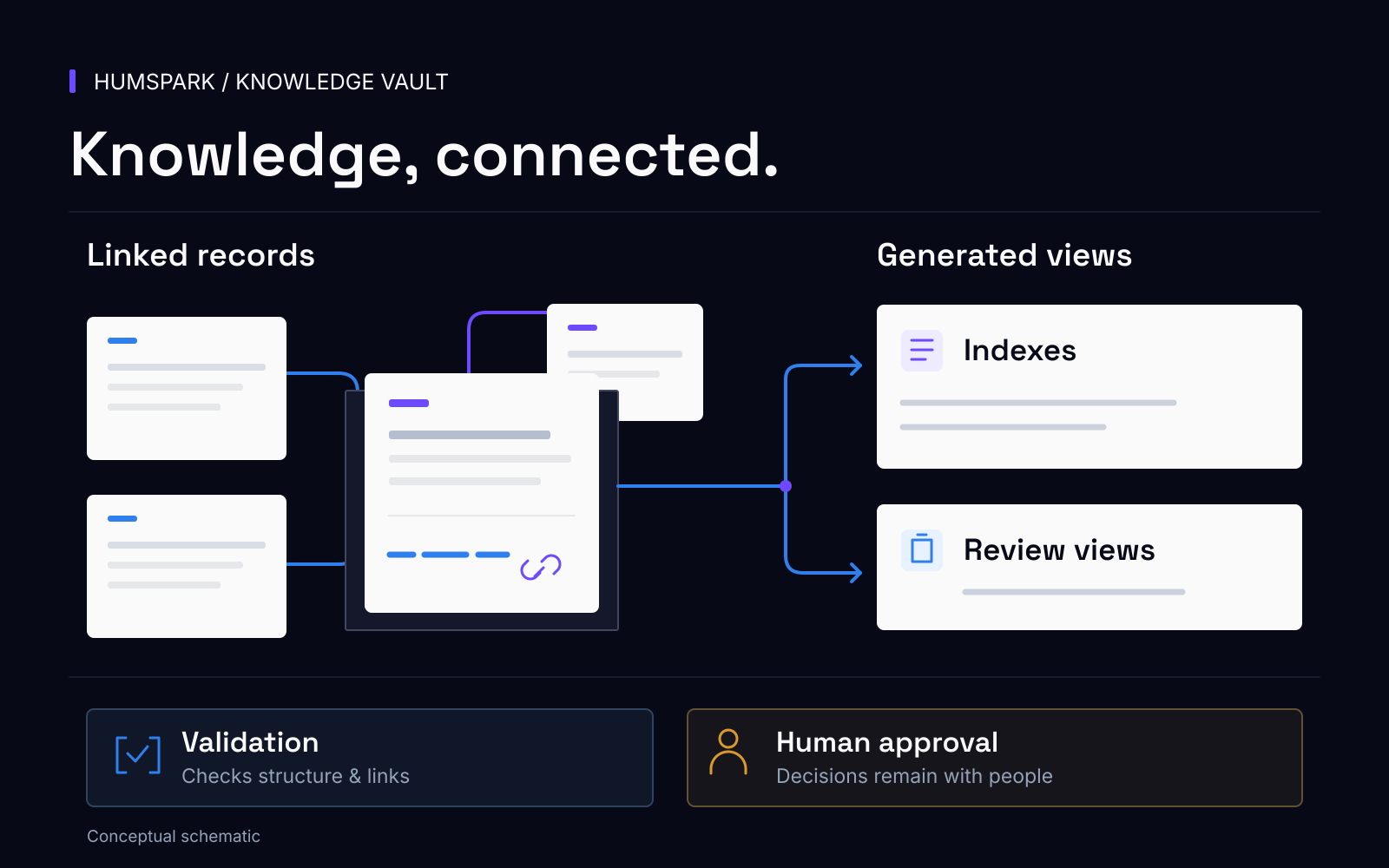
A collaborator can move from an overview to a relevant domain and then to a particular record. Client and project records have stable locations, with links to related material and external resources where appropriate. Keeping those relationships in the documents makes the structure useful beyond a single interface: the files can be read directly, followed through ordinary links and reviewed as changes in Git.
We also created templates for recurring records, including clients, projects, decisions, meetings, sources and delivery guidance. Client and project creation tools provide a repeatable way to start records from those structures. The initial repository included fictional examples to demonstrate the shape without presenting them as live engagements.
Giving information a clear status
A useful vault needs more than a place to put notes. Its readers need to know what they can rely on and what still needs a decision. We defined a schema for record type, ownership, lifecycle status, authorship and sensitivity, with fields for sources and verification where relevant. The working rules set out an order for resolving authority and a route for collaborators to read the context relevant to their work.
That distinction matters for AI-assisted work. The vault can record who or what produced a document, but authorship alone does not make the content human-reviewed. The operating contract reserves approvals and claims such as client acceptance for a human decision. It also separates implementation, runtime, deployment and acceptance states in project records, so one kind of evidence is not used as a substitute for another.
Stable paths support the same discipline. A record can change from draft to stable or deprecated through its metadata without casually moving the file and breaking the links that point to it. Sources and relationships remain available alongside the current record, helping a future reader trace how the information fits together.
From operating structure to working documents
The foundation was followed by a set of reusable business-document drafts. The pack covers stages from proposal and quotation through design briefing, technical planning, kickoff, change requests, acceptance and handover, and care. Each is a starting point to be completed and reviewed for an actual engagement, with space for the relevant responsibilities, evidence and decisions.
This connected the vault's operating structure to the documents an agency needs to prepare its work. For example, a technical plan can point to the separate code repository and record the checks and release responsibilities for a project. A handover template distinguishes delivery evidence, deployment and client acceptance, so those events can be recorded separately when they occur. The drafts do not themselves create agreed terms or prove that a project has been accepted.
The result
Argonous built a knowledge-vault foundation with a defined structure, navigation, templates, record-creation tools and local consistency checks. The vault is in active use by HumSpark.
The vault provides a clearer starting point for agency work: collaborators can find relevant context, see a record’s status and ownership, follow its sources and begin from a reusable document. HumSpark can develop the vault as its working practices evolve.